Yu-Gi-Oh! 1999

⸸ 東京ドーム 1999 — Duelist Legend ⸸
Yu-Gi-Oh!'s first competitive format
The Resurrection of a Lost Format
What Yu-Gi-Oh! Looked Like in 1999 — The First Competitive Yu-Gi-Oh! Tournament to be Played for All of Japan
Before there was a standardized game, before defined phases and universal rulings, before competitive play had structure, Yu-Gi-Oh! existed in fragments.
Across Japan in 1999, Duel Monsters, Konami's new take on the Yu-Gi-Oh! card game, was already popular. Cards circulated through scattered means: early booster-style releases like Volume 1, 2, and 3, promotional inserts in magazines, limited box products, and most commonly through Carddass vending machines. Access was inconsistent, and ownership defined play more than design. Two players in different parts of Tokyo could be playing what appeared to be the same game while operating under entirely different assumptions.
Card shops filled the gaps. House rules emerged organically. Interactions were debated, localized, and often contradicted from store to store. Even fundamental mechanics lacked consistency. Cards like Ultimate Offering did not have a universally accepted function. There was no singular authority enforcing how the game should be played. At the same time, Kazuki Takahashi was still actively developing the manga. Duel Monsters in its original form was fluid, adapting to narrative needs rather than competitive balance. Konami had only recently taken control of the property from Bandai, and the process of transforming it into a structured trading card game was still underway. The “Expert Rules” that would later formalize Yu-Gi-Oh! into a modern system had not yet been fully realized.
This was the environment leading into July 1999.
Tokyo itself mirrored that instability and momentum. The city was deep in the Y2K era—saturated with technology, design experimentation, and a sense that the future had arrived before the century had quite ended. Yu-Gi-Oh!’s visual identity reflected that moment precisely. Its cards fused ancient themes—rituals, demons, Egyptian mythology—with emerging digital art techniques: sharp black outlines, gradient color transitions, early texture shading. The aesthetic was both archaic and futuristic, like an old world rendered through new tools.
The event known as Duelist Legend in Tokyo Dome was the first unified official competitive Yu-Gi-Oh! tournament in Japan. It was the moment the scattered culture of early Duel Monsters was gathered, shaped, and made public as a true tournament game. It was the standardization point. It was the first time Yu-Gi-Oh! was pressed into a national competitive form, with a shared expectation of rules, card access, and play structure. Instability had become foundation. Before this moment, there were duels. Now there was an official competitive card game.
The response exceeded all expectations.
Over 55,000 people attended—more than 15,000 beyond projected capacity. The draw was not only competition, but scarcity. The event marked the release of Exodia the Forbidden One (Head of Exodia), the final piece of a card that had been distributed slowly and unevenly across previous products. Exodia was not just powerful—it was symbolic. A collector’s endpoint, assembled through effort and access.
There were not enough copies.
What followed was disorder. Crowds surged. Lines broke down. Frustration escalated into what has since been recorded as a riot. The same event that attempted to standardize the game also exposed the instability of its distribution and demand. It was both the foundation of competitive Yu-Gi-Oh! and a demonstration of how unprepared the system was to support it.
And yet, within that chaos, the first true format existed.
The Tokyo Dome 1999 Format represents that moment of enforced standardization. A defined cardpool. A unified ruleset—imperfect, but shared. The first Limited list, restricting Raigeki, Dark Hole, and Trap Hole. Core mechanical rules that would shape early play: no hand size limit, no first turn draw, simplified combat without a formal damage step, and a unique deck-out condition based on Life Points rather than immediate loss.
For the first time, Duel Monsters was played as a competitive system.
Then it disappeared.
No verified winning decklist survives. The rules themselves were not preserved in a complete, official form. As Konami moved forward, refining the game with new sets, the Tokyo Dome environment was left behind. Unlike Magic: The Gathering, which meticulously documented its early tournaments, Yu‑Gi‑Oh!’s first competitive event was largely forgotten. We don’t even know what deck won. No record survives. The players who competed that day carried their knowledge home, and the format went unplayed for a quarter of a century.
For over 25 years, it remained effectively lost.
The OCG Archives Resurrection Project required building from a format from fragments. We had to source Japanese manuals, translate card text, and cross‑reference rulings that had never been formally codified. We pored over V‑Jump scans from 1999, hunted down ancient tournament reports, and reconstructed a format from fragments.
We did what Konami couldn’t, wouldn’t, or simply refused to do.
The result is a format that is not just a curiosity for vintage Yu‑Gi‑Oh! enthusiasts, but a vital piece of TCG history. To play Tokyo Dome 1999 is to understand the deepest roots of this game. It offers insight into how card games are designed, how rules evolve, and how a franchise that began in a manga and vending machines became a global phenomenon. For anyone seeking to grasp Takahashi’s legacy—as an artist, a storyteller, and a game designer—this format is essential.
This is where competitive Yu-Gi-Oh! begins.
This is 1999 Tokyo Dome Format. Resurrected.
↗ View TD1999 Format on Format Library →
Format Overview & Core Identity
The Tokyo Dome 1999 Format reconstructs the environment of the first major official Yu-Gi-Oh! tournament, held in July 1999 at the Tokyo Dome. It captures the game at its first point of standardization: a defined cardpool, a unified ruleset, and the game's inaugural Limited list.
Cardpool: Limited to cards available prior to the event (Volume 1 ~ Booster 6, promos, etc.)
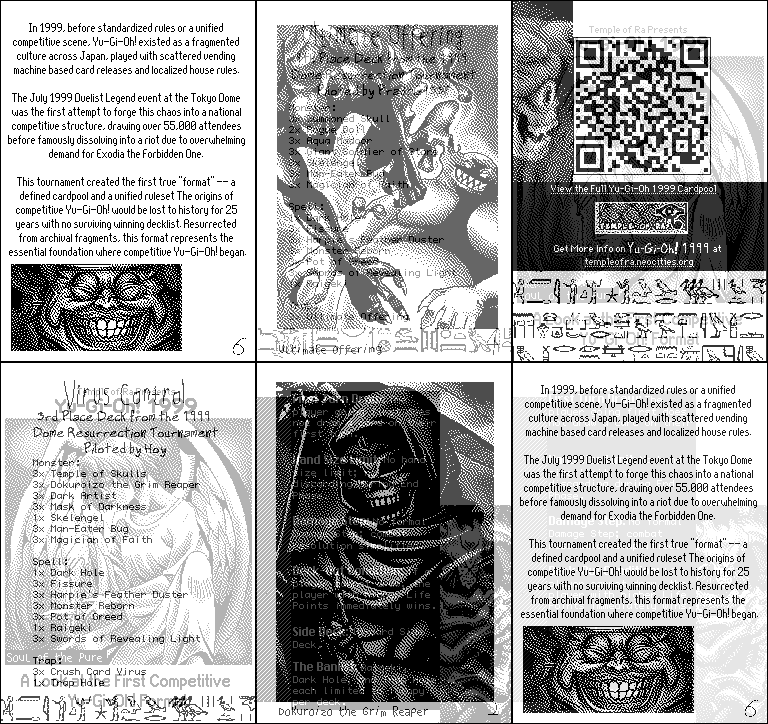
MINI ZINE
An 8-panel printable zine providing a quick look at the format.
↗ Download the 1999 Format Zine (PDF) →
Core Rulings & Limited List
First Turn Draw
The player going first does not draw a card on their first turn.
Hand Size Limit
There is no hand size limit. No discarding during End Phase.
Damage Step
There is no formal Damage Step. Combat resolution is simplified.
Deck-Out Condition
If a player cannot draw, the player with the higher Life Points immediately wins the Duel.
Side Deck
Each player may use a 10-card Side Deck (It was either 10 cards, or no cards).
Limited Cards
Raigeki, Dark Hole, and Trap Hole are each limited to 1 copy per deck — the first Limited list.
Notable Card Behaviors
Traps & Continuous Legacy
In Series 1, most Trap Cards were not destroyed immediately after activation. They remained on the field unless their original printing specified otherwise. For example, Kunai with Chain stays on the field permanently, functioning similarly to Call of the Haunted for both of its effects.
Cards That Do Not Leave the Field Upon Activation
- Dragon Capture Jar
- Ultimate Offering
- Kunai with Chain
Exception – Crush Card Virus: It sacrifices itself and the monster used for its activation cost. Although it leaves the field, it does so through a different mechanic (sacrifice) rather than destruction.
Original Crush Card text: “Tribute 1 DARK monster with 1000 or less ATK. Check all monsters on your opponent's side of the field, your opponent's hand, and all cards they draw (until the end of your opponent's 3rd turn after this card's activation), and destroy all monsters with 1500 or more ATK.”
Rulings Philosophy & Sources
This format uses the final rulings of Series 1 when available. Given the looseness of early rules and the scarcity of concrete sources from Japan’s pre-internet / early internet era, some liberties are taken. If an early ruling or definitive source cannot be found, the earliest available ruling is used, or the Goat Format ruling is applied as a backup. Every effort is made to preserve authenticity while enabling consistent play.
Primary Sources
- OCG Official Rulebook, 1st Edition (English Translation)
- 4th Edition Rulebook Transcription
- Expert Rules Document (Japanese Wiki)
- Booster 6 FAQ Cards (Yugipedia)
- LA Times: "Cartoon Craze Boils Over in Japan" (1999)
Secondary Sources
- Yu-Gi-Oh!'s Weird First Banlist (Janjo Zone)
- The Broken Flip Cards of 1999 Yu-Gi-Oh! | Volume 3 (Janjo Zone)
Ruling philosophy: Where definitive Series 1 rulings are unavailable, this format applies the earliest available ruling or (as a final reference) established Goat Format rulings to ensure consistent play.
Meta Decks
These are serious decks that have or could win a tournament.
Vanilla Beat
1st Place Deck from the 1999 Dome Resurrection Tournament // Piloted by KiryuRyo
View Deck →Vanilla Beat
2nd Place Deck from the 1999 Dome Resurrection Tournament // Piloted by Gerhat
View Deck →Ultimate Offering Control
4th Place Deck from the 1999 Dome Resurrection Tournament // Piloted by PradaG1337
View Deck →Harpies
5th Place Deck from the 1999 Dome Resurrection Tournament // Piloted by SolEmerald
View Deck →Starter Decks
Casual, entry level decks that might have been seen at local card shops during the era.
Umi
Umi 1999 focuses on using the Field Spell 'Umi' in order to boost the attack of cards like Great White to 1800, as well as to make the fusion materials for Deepsea Shark hit harder. Steel shell lets Deepsea Shark crash with Summoned Skull. Aggressive deck with a focus on getting in damage whenever possible.
View Deck →Earth Aggro
Earth Aggro 1999 leverages the power of "Invigoration" in combination with Giant Soldier of Stone and The Beautiful Headhuntress to create a mid-range aggro deck that hopes to be able to both wall up and attack as needed. Warrior side deck helps get around Card Crush Virus.
View Deck →Kamionwizard Crush
Mystical Elf is a defensive staple, while Curtain of the Dark Ones, though weak, serves as a viable target for Crush Card Virus. Together, they fuse into "Kamionwizard." With only 1300 attack, it's not much, but at this stage of the game, that extra special summon can provide the tempo you need to fully capitalize on the powerful effects of Crush Card Virus.
View Deck →Harpies
Leverages Elegant Egotist to flood the field with Harpie Lady Sisters. Highly aggro, but lacks in true killing power due to the limited attack of the Sisters. Cards like Gust Fan and Mountain help keep the pressure up. Skelengel gets you to Egotist faster, as that's the lynchpin of the deck.
View Deck →Insect Armor OTK
Insects 1999 focuses on powering up Giant Flea with "Insect Armor with Laser Cannon" to reach 2200 attack. In theory, the deck can nearly OTK if your opponent has a Summoned Skull in the graveyard. Two Fleas with Armor hit for 2200 each—boosted by Forest to 2400—dealing 4800 total. Add 2500 from Summoned Skull, and you're at 7300 damage.
View Deck →Dokurorider
The key feature of this deck is the combo of tributing a Summoned Skull from your hand to summon Rider, then reviving Summoned Skull with Monster Reborn. While this combo can be inconsistent, when executed, it puts your opponent on a two-turn clock by dealing over 4000 damage.
View Deck →Stall Burn
Without using Magician of Faith to recycle the spells, you can deal 5700 damage with the (honestly weak) burn spells in this format. Recycle 3 Oozakis with Faith? That's 8000 LP damage. Makes use of Castle Walls as a pseudo burn card to increase damage dealt when your opponent attacks into one of your 2000 DEF walls. Experimental kind of deck.
View Deck →Flame Swordsman
This deck aims to capitalize on the two FIRE fusion monsters: the legendary Flame Swordsman and his spellcaster counterpart, Vermillion Sparrow. Three copies of Salamandra are included to boost your monsters' attack, but saving the swords for a game-winning push is always a viable strategy. Vermillion Sparrow equipped with three Salamandra can deal a massive 4000 damage—a huge blow to your opponent.
View Deck →
⸸Temple of Ra by HOUDINI Magazine — Hosted on Neocities — Rest in Peace Kazuki Takahashi — Temple of Ra Revived on March 18th 2026 —  ⸸
⸸